
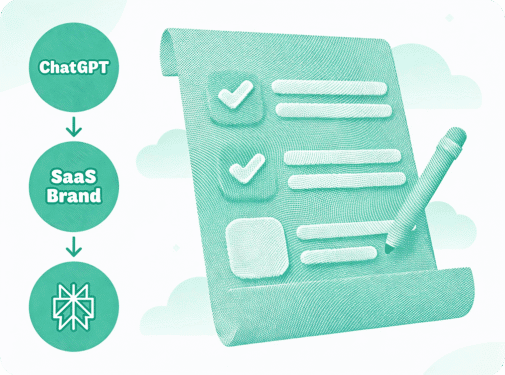

Your prospects have stopped Googling. They’re asking ChatGPT which CRM to use. They’re asking Perplexity to compare email marketing tools. They’re asking Gemini to recommend project management software for remote teams.
And your SaaS brand? Nowhere to be found.
This isn’t a hypothetical future. It’s happening right now. According to recent data, over 40% of Gen Z prefers using AI assistants over traditional search for product research. And it’s not just younger users. Decision-makers at B2B companies are increasingly turning to AI tools for vendor research, competitive analysis, and solution discovery.
The SaaS brands that figure out AI search optimization now will dominate their categories for years. The ones that don’t will watch their competitors get recommended while they remain invisible.
This guide breaks down exactly how to get your SaaS brand mentioned by ChatGPT, Perplexity, Gemini, and other AI systems, based on what we’ve learned generating over $50M in pipeline for SaaS clients through organic channels.
Why Traditional SEO Won’t Save You Here
Before we get into tactics, you need to understand why your current SEO strategy, even if it’s working well for Google rankings, won’t automatically translate to AI visibility.
Google shows you a list of links and lets you choose. AI systems give you an answer. That’s a fundamentally different interaction, and it requires a fundamentally different approach.
When someone asks ChatGPT “What’s the best email marketing tool for e-commerce?”, it doesn’t return ten blue links. It synthesizes information from its training data and (in some cases) real-time web access to give a direct recommendation. Your goal isn’t to rank. It’s to be the answer.
This changes everything about how you need to think about content, positioning, and digital presence.
Here’s what doesn’t work: Publishing blog posts optimized for long-tail keywords. Building backlinks from random domains. Stuffing your site with content that technically mentions your product category but adds no real value.
Here’s what does work: Building genuine topical authority that establishes your brand as an entity AI systems recognize and trust. Creating content that serves as a primary source of truth for your category. Developing a digital footprint that consistently associates your brand with specific problems and solutions.
How AI Systems Decide What to Recommend
To get mentioned by AI, you need to understand how these systems form their “opinions” about which products to recommend.
LLMs like GPT-4, Claude, and Gemini don’t have opinions in the human sense. They have statistical associations learned from training data. When someone asks for a recommendation, the model is essentially predicting what a helpful response would look like based on patterns in the content it was trained on.
This means three things matter enormously:
Entity Recognition: Does the AI system recognize your brand as a distinct entity in your category? If your brand doesn’t exist as a clear concept in the model’s understanding, it literally cannot recommend you.
Contextual Association: When your brand appears in training data, what context surrounds it? Is it mentioned alongside problems you solve? Is it discussed in comparison to competitors? Is it referenced by authoritative sources?
Sentiment and Authority: How do sources discuss your brand? Positive reviews, case studies, and expert endorsements create stronger positive associations than neutral or negative mentions.
Perplexity and similar AI search tools add another layer: real-time web access. These systems can pull current information from the web, which means your live content strategy matters, not just what existed when the base model was trained.
The Entity-First Framework for AI Visibility
Based on our work with SaaS clients, including one engagement that generated $6M in pipeline for an Email Data SaaS, we’ve developed what we call the Entity-First Framework for AI visibility.
The core principle: Before you can be recommended, you must be recognized. And recognition comes from consistent, authoritative presence across the information sources AI systems learn from.
Step 1: Define Your Entity Clearly
AI systems need to understand what your brand is, what category you operate in, and what specific problems you solve. This sounds obvious, but most SaaS companies are surprisingly vague about this in their content.
Your homepage probably says something like “The modern platform for [vague business outcome].” That’s great for humans who can click around and figure out what you do. It’s terrible for AI systems trying to categorize and recommend you.
Action step: Create an entity definition document that answers: What category does your product belong to? (Be specific. “Sales enablement platform” not “business software.”) What are the top 5 problems you solve? Who are your direct competitors? What makes you different from each of them?
This document becomes the foundation for all your content. Every piece you publish should reinforce these entity associations.
Step 2: Build Topical Authority Around Your Core Problems
AI systems learn topic associations from content patterns. If your brand consistently appears in high-quality content about specific problems, you become associated with those problems in the model’s understanding.
This isn’t about publishing more content. It’s about publishing the right content with genuine depth and expertise.
For each core problem you solve, you need: A definitive guide that could serve as the primary reference on that topic. Supporting content that explores specific angles, use cases, and scenarios. Content that explicitly connects the problem to your solution (without being salesy). Third-party content that mentions your brand in context of this problem.
The goal is information gain. Creating content that adds genuine value to the conversation, not content that just repackages what already exists. AI systems are trained to recognize and prefer original, authoritative sources.
We helped an Email Marketing SaaS achieve 600% lead growth in 8 months by building this kind of topical depth. They went from being one of many tools in their category to being the brand that consistently appeared when AI systems discussed email deliverability and sender reputation.
Step 3: Get Mentioned by Authoritative Sources
Not all mentions are created equal. AI systems weight information based on source authority, just like traditional SEO, but with different signals.
The sources that matter most for AI training data include: Industry publications and analyst reports. Reputable review sites (G2, Capterra, TrustRadius). Educational content from recognized experts. Academic or research-oriented content. High-authority media coverage. Wikipedia (yes, really, if your brand is notable enough).
Getting mentioned by these sources requires genuine PR and thought leadership work. You need original research, unique insights, or newsworthy company developments that give journalists and analysts a reason to write about you.
Action step: Audit your current presence on authoritative sources. Where are you mentioned? What context? Where are your competitors mentioned that you’re not? Create a target list of publications and work backward to develop content and angles that could earn coverage.
Step 4: Own Your Comparison Narratives
When someone asks an AI “What’s the difference between [Your Brand] and [Competitor]?”, what answer do you want them to get?
If you’re not actively shaping this narrative, your competitors are. Or worse, random forum posts and outdated reviews are.
Create comparison content that: Is genuinely fair and acknowledges competitor strengths. Clearly articulates your differentiation without being salesy. Addresses the specific use cases where each option makes sense. Gets published on your site AND syndicated to other platforms.
This content serves double duty: it helps with traditional SEO for “vs” and “alternative” keywords, and it shapes the narrative AI systems learn when synthesizing information about your category.
Step 5: Optimize for Real-Time AI Search (Perplexity, Bing Chat, Google SGE)
While base LLMs like ChatGPT rely primarily on training data, newer AI search tools like Perplexity can access current web content. This means your live content strategy directly impacts whether you appear in these results.
Optimize for real-time AI search by: Keeping content fresh and updated. AI search tools often prefer recent content for queries where recency matters. Using clear, direct language that’s easy for AI to extract and quote. Structuring content with clear headers that match common question formats. Including specific data, statistics, and concrete examples that AI systems can cite. Building content that directly answers questions your prospects ask.
The format matters here. AI search tools love content structured as clear answers to specific questions. FAQ pages, comprehensive guides with clear sections, and content that gets straight to the point all perform better than meandering long-form content that buries the useful information.
The Content Types That Drive AI Mentions
Not all content has equal impact on AI visibility. Based on our analysis of which SaaS brands get mentioned most frequently by AI systems, certain content types consistently outperform:
Original Research and Data: If you publish original survey data, benchmark reports, or industry analysis, AI systems will cite you as a primary source. This is one of the fastest paths to AI visibility because you’re creating information that doesn’t exist elsewhere.
Definitive Guides: Comprehensive guides that could serve as the reference material for a topic. Not “10 Tips for X” content, but genuine deep-dives that cover a subject exhaustively.
Use Case Documentation: Detailed content about how specific types of users or industries use your product. When someone asks AI for a tool “for [specific use case]”, this content helps you appear.
Expert-Led Content: Content attributed to recognized experts in your space. Author authority matters. Content from your CEO or recognized industry experts carries more weight than anonymous blog posts.
Product Documentation: Surprisingly, your help docs and product documentation influence AI understanding of your capabilities. Clear, comprehensive documentation helps AI accurately describe what your product does.
Measuring AI Visibility (What Actually Matters)
You can’t optimize what you can’t measure. Here’s how to track whether your AI visibility efforts are working:
Manual Testing: Regularly query ChatGPT, Perplexity, Claude, and Gemini with questions your prospects would ask. Document when you’re mentioned, in what context, and how you’re positioned relative to competitors. Do this monthly and track trends.
Brand Monitoring: Track mentions across the web using tools like Mention or Brand24. Growing presence on forums, review sites, and publications indicates you’re building the kind of footprint that influences AI training.
Referral Traffic Analysis: Some AI search tools drive trackable referral traffic. Monitor for traffic from Perplexity, Bing, and other AI-powered search interfaces.
Qualitative Feedback: Ask new leads how they found you. “I asked ChatGPT” or “Perplexity recommended you” are signals your strategy is working.
Common Mistakes to Avoid
Thinking this is separate from SEO: AI visibility and traditional SEO aren’t competing strategies. They’re complementary. The work you do to build genuine topical authority helps both.
Focusing only on ChatGPT: Different AI systems have different training data and retrieval methods. A multi-platform approach is essential.
Expecting instant results: Base model training happens periodically. It can take months for new content to influence ChatGPT’s responses. Real-time AI search tools respond faster, but building genuine authority takes time.
Gaming the system with thin content: AI systems are trained to recognize and prefer authoritative, high-quality sources. Flooding the web with low-value content won’t help and might hurt your brand’s perceived authority.
Ignoring the basics: Your website still needs to be technically sound, your content still needs to be well-structured, and your brand still needs to deliver genuine value. AI visibility is built on the same foundation as any other organic strategy.
The 90-Day Action Plan
If you’re starting from scratch, here’s a prioritized plan:
Days 1-30: Foundation. Complete your entity definition document. Audit current AI visibility across major platforms. Identify your 3-5 core problems/topics to own. Map your competitor landscape and their AI visibility.
Days 31-60: Content Development. Create or refresh your definitive guide for each core topic. Develop comparison content for your top 3 competitors. Publish original research or data if you have access to unique insights. Update product documentation for clarity.
Days 61-90: Distribution and Authority Building. Execute PR strategy to earn mentions on authoritative sources. Syndicate content across relevant platforms. Build expert presence through guest posts and podcasts. Begin monthly AI visibility monitoring.
The Bottom Line
AI search isn’t replacing Google tomorrow. But the shift is happening faster than most SaaS marketers realize. The brands that invest in AI visibility now will have a massive advantage as these platforms become more central to how people discover and evaluate software.
The good news: the fundamentals haven’t changed. Building genuine authority, creating valuable content, and establishing clear brand positioning. These strategies work for AI visibility just like they work for traditional SEO. The difference is execution and understanding how AI systems interpret and surface information.
The brands that figure this out won’t just survive the AI search transition. They’ll come out stronger, with more defensible competitive moats and more predictable organic pipeline.
Ready to Build Your AI Visibility Strategy?
Most SaaS brands are still invisible to AI search. At B2BMint, we’ve helped clients generate over $50M in organic pipeline by building the kind of semantic authority that gets noticed by Google and by AI systems.
Want to see where your brand stands? Get a free AI visibility audit that shows exactly how ChatGPT, Perplexity, and Gemini perceive your brand, and what it would take to become the recommended solution in your category.
No sales pitch. Just a clear picture of your current AI visibility and actionable recommendations you can implement yourself or with our help.