
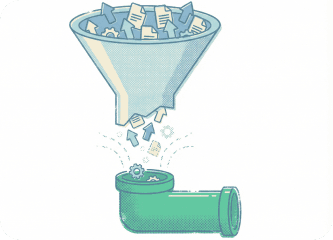

Your SEO dashboard looks great. Traffic is up. Rankings are climbing. The blog is getting more visitors than ever.
But when your CEO asks how many deals came from organic search last quarter, you don’t have a good answer.
This is the reality for most SaaS marketing teams. They’ve invested heavily in content. They’ve built a blog with hundreds of posts. They’ve earned backlinks and improved domain authority. And yet, when they trace revenue back to source, organic content barely registers.
The problem isn’t that content marketing doesn’t work. The problem is that most SaaS content strategies are optimized for the wrong outcomes. They’re built to generate traffic, not pipeline. And those are very different things.
This guide breaks down exactly why that gap exists and how to fix it. We’ll cover the specific strategic shifts that have helped our clients generate over $50M in organic pipeline, including 600% lead growth for an Email Marketing SaaS and $6M in pipeline for an Email Data platform.
The Traffic Trap: How SaaS Content Strategies Go Wrong
Most SaaS content strategies fail for predictable reasons. And they usually fail while looking successful on surface-level metrics.
Here’s the typical story. A SaaS company decides to invest in content marketing. They hire a content manager or agency. They do keyword research and find hundreds of terms with decent search volume. They start publishing blog posts targeting those keywords. Traffic grows. The team celebrates.
But six months later, when leadership asks about ROI, the content team can’t draw a clear line from their work to revenue. They point to traffic numbers, maybe some email signups. But actual pipeline? Closed deals that started with content? The data is murky at best.
The fundamental issue is that most keyword research prioritizes search volume over commercial intent. Teams chase terms that lots of people search for without asking whether those people are actually potential buyers.
Consider the difference between these two queries: “What is email marketing” gets 40,000 monthly searches. “Email marketing software for ecommerce” gets 800. Most content strategies would prioritize the first one. But the person searching “what is email marketing” is probably a student or someone just starting to learn. The person searching for “email marketing software for ecommerce” is likely evaluating solutions right now.
One query has 50x the volume. The other has 50x the buying intent. Guess which one actually generates pipeline?
The Five Content Mistakes Killing Your Pipeline
After analyzing dozens of SaaS content strategies, we’ve identified five patterns that consistently lead to the traffic-without-pipeline problem.
Mistake 1: Building for Awareness When You Need Demand
There’s a place for top-of-funnel educational content. But most SaaS companies dramatically over-invest in awareness content while under-investing in content that captures existing demand.
Think about your content mix right now. What percentage targets people who already know they have a problem and are actively looking for solutions? If the answer is less than 40%, your funnel is upside down.
The math is simple. Awareness content requires nurturing. Someone who reads “What is customer success” might become a buyer in 18 months. Someone searching “customer success software comparison” might become a buyer this quarter. If you need pipeline now, you need to prioritize the second type of content.
Mistake 2: Ignoring the Buyer Journey Within Your Content
Even when SaaS companies create bottom-of-funnel content, they often fail to guide readers toward conversion. The content answers a question, then… nothing. No clear next step. No logical path forward.
Every piece of content should have a purpose beyond ranking. What do you want someone to do after reading? If the answer is “sign up for our newsletter,” you’re leaving pipeline on the table. The person reading a comparison post doesn’t want your newsletter. They want to see your product.
Map each piece of content to a specific action that matches reader intent. Comparison content should lead to demos or free trials. Problem-focused content should lead to solution pages. Technical content should lead to documentation or developer signups.
Mistake 3: Writing for Search Engines Instead of Buyers
You’ve seen these posts. They hit every semantic keyword. They have the right header structure. They’re perfectly optimized for search algorithms. And they’re completely unreadable for actual humans making buying decisions.
B2B buyers are sophisticated. They can smell generic, over-optimized content from a mile away. When they land on a post that feels like it was written by an algorithm for an algorithm, they bounce. And they remember that your brand produces low-quality content.
The best-performing content for pipeline serves dual purposes. It’s structured and comprehensive enough to rank, and it’s genuinely useful and engaging enough to convert. These aren’t mutually exclusive, but achieving both requires real expertise and effort.
Mistake 4: No Connection to Product or Solution
Many SaaS blogs read like industry publications. They cover trends, share best practices, provide tips. They rarely mention the company’s actual product.
This comes from a fear of being “too salesy.” But there’s a massive difference between pushy sales content and naturally connecting problems to your solution. If someone reads your post about solving a problem and doesn’t realize your product solves that problem, you’ve failed.
Every piece of content should make clear how your product relates to the topic. Not through aggressive CTAs, but through natural integration. Show screenshots. Reference features. Link to relevant product pages. Make the connection obvious.
Mistake 5: Publishing Without a Semantic Strategy
Random acts of content don’t build authority. Publishing 50 blog posts on 50 unrelated topics might generate some traffic, but it won’t establish your brand as the definitive source on anything.
Search engines (and AI systems) reward topical depth. They want to see that you’ve comprehensively covered a subject from multiple angles. A brand that publishes 20 interconnected pieces on a specific problem will outperform a brand that publishes 100 scattered posts on various topics.
More importantly, topical authority translates to buyer trust. When prospects see that you’ve deeply explored their specific challenges, they perceive you as experts. That perception directly influences pipeline.
The Pipeline-First Content Framework
Fixing these problems requires rethinking how you approach content strategy. Here’s the framework we use with clients that has generated measurable pipeline results.
Step 1: Map Your Content to Revenue Stages
Before creating any content, understand exactly how it connects to revenue. We use a simple framework with three categories.
Capture Content: Targets people actively searching for solutions. These are comparison posts, alternative pages, pricing guides, and feature-specific content. This content should convert within 1-2 sessions.
Nurture Content: Targets people who have a problem but aren’t yet evaluating solutions. These are problem-focused guides, methodology content, and industry analysis. This content should move readers toward solution awareness.
Authority Content: Establishes your brand as the expert in your space. This is original research, thought leadership, and comprehensive guides. This content builds trust that influences conversions across all other content.
Most struggling content strategies have 80% awareness content, 15% authority content, and 5% capture content. For pipeline, you want closer to 40% capture, 35% nurture, and 25% authority.
Step 2: Build Content Clusters Around Buying Problems
Instead of targeting random keywords, build comprehensive content clusters around the specific problems your product solves.
Start by identifying your 3-5 core value propositions. What are the main reasons customers buy from you? For each one, build a cluster of content that covers every angle a buyer might research.
For example, if you sell email deliverability software, one cluster might focus on “email landing in spam.” That cluster would include: a definitive guide on email deliverability, specific posts on authentication (SPF, DKIM, DMARC), content about IP reputation, posts about list hygiene, comparison content for deliverability tools, and content about measuring and monitoring deliverability.
Each piece in the cluster links to related pieces and to your product. The cluster comprehensively covers the topic while naturally positioning your solution.
When we implemented this approach for an Email Marketing SaaS client, they saw 600% growth in qualified leads within 8 months. The traffic increase was modest. The pipeline increase was dramatic. That’s the difference between random content and strategic clusters.
Step 3: Optimize Every Page for Conversion, Not Just Traffic
Traffic optimization and conversion optimization are different disciplines. Most content teams focus exclusively on the first.
For every piece of content, ask: What’s the primary CTA and does it match the reader’s intent? Is there a clear value proposition for taking that action? Are there multiple, non-intrusive conversion opportunities throughout the content? Does the page load fast and work well on mobile? Is there social proof visible (logos, testimonials, case studies)?
Small conversion improvements compound dramatically. Improving your blog-to-lead conversion rate from 0.5% to 1.5% triples your pipeline from existing traffic. That’s often more impactful than doubling traffic to pages that don’t convert.
Step 4: Create Content That Qualifies, Not Just Attracts
The leads that matter aren’t just any leads. They’re qualified leads who fit your ICP and have genuine buying potential.
Your content should pre-qualify readers. When you write specifically about problems your ideal customers face, using language they use, referencing their specific context, you naturally attract better-fit prospects and repel poor fits.
Generic content attracts generic traffic. Specific content attracts specific buyers. A post titled “Project Management Tips” attracts everyone. A post titled “How B2B SaaS Teams Manage Product Launches Without Missing Deadlines” attracts exactly who you want.
This means lower total traffic but higher conversion rates and better lead quality. That trade-off is almost always worth it.
Step 5: Build the Attribution System Before You Need It
You can’t optimize what you can’t measure. Before scaling content investment, make sure you can actually trace pipeline back to content.
At minimum, you need: First-touch and multi-touch attribution in your CRM. UTM parameters on all content CTAs. Integration between your blog analytics and marketing automation. The ability to see which content pieces influenced closed deals, not just which generated leads.
Most SaaS companies track content performance by traffic and maybe form fills. The companies that win track content performance by influenced pipeline and revenue. That data completely changes which content you prioritize.
The Content Audit: Finding Your Pipeline Leaks
If you have existing content, the fastest path to more pipeline is fixing what you already have. Here’s how to audit your content library for pipeline potential.
Pull your top 50 pages by traffic. For each one, evaluate: What’s the search intent behind this content? Is it informational, navigational, or transactional? Does the content match that intent? Is there a clear conversion path? What action do you want readers to take? Does the content mention your product or solution? Is it connected to other relevant content on your site?
You’ll likely find that many high-traffic pages have no conversion path at all. They rank, they attract visitors, those visitors read and leave. These are your biggest opportunities.
For each high-traffic page without conversions, add relevant CTAs. Create logical next-step content. Link to product pages. Test different offers. Often, small changes to existing content generate more pipeline than new content creation.
Next, identify your highest-converting pages. What do they have in common? Often, you’ll find patterns. Maybe your case studies convert 5x better than blog posts. Maybe comparison pages outperform everything else. Double down on what works.
Real Numbers: What Pipeline-First Content Actually Delivers
Let’s talk specifics. What kind of results should you expect when you shift from traffic-first to pipeline-first content?
We’ve worked with SaaS companies across multiple categories, and while results vary by market and starting point, certain patterns are consistent.
An Email Data SaaS came to us with strong traffic but minimal pipeline from content. Within 12 months of implementing the pipeline-first framework, they generated $6M in attributable pipeline from organic search. Traffic grew modestly. Pipeline grew dramatically.
An Influencer Marketing Platform had invested heavily in awareness content for years. We restructured their content strategy around buying-stage topics and commercial intent clusters. The result was $50M in SEO-attributed pipeline.
In both cases, the shift wasn’t about creating more content. It was about creating the right content, structured the right way, with clear paths to conversion.
Key metrics to watch: Organic traffic to demo/trial pages (not just blog traffic). Content-attributed pipeline in your CRM. Conversion rate from organic visitors to MQLs. Time from first organic touch to opportunity creation.
If these metrics aren’t improving, your content strategy isn’t working, regardless of what your traffic numbers say.
The 30-Day Pipeline Content Reset
You don’t need to rebuild your entire content operation overnight. Here’s a 30-day plan to start shifting toward pipeline-first content.
Week 1: Audit and Prioritize. Review your top 30 pages by traffic. Score each for commercial intent (high, medium, low). Identify your current conversion paths. Check attribution setup in your CRM.
Week 2: Quick Wins. Add relevant CTAs to your top 10 high-traffic, low-conversion pages. Create one comparison or alternative page for your top competitor. Update your highest-traffic pages with product mentions and internal links.
Week 3: Cluster Planning. Define your 3 core buying problems. Map the content cluster for each (10-15 pieces per cluster). Identify gaps in your existing content that need filling.
Week 4: Execution Start. Create the pillar page for your most important cluster. Plan the supporting content calendar. Set up weekly pipeline attribution reviews.
This gets you moving. The real transformation happens over 90-180 days as you build out complete clusters and optimize based on pipeline data.
Why Most Teams Struggle to Make This Shift
If pipeline-first content is so effective, why isn’t everyone doing it? A few common barriers.
Metric inertia. Teams have been reporting on traffic for years. Shifting to pipeline metrics can make historical performance look worse, which is politically uncomfortable. But vanity metrics are vanity metrics. Eventually, leadership will ask about revenue.
Skill gaps. Writing content that ranks AND converts requires both SEO expertise and conversion copywriting skills. Most content teams are strong on one but not both. Bridging that gap often requires external help.
Patience. Pipeline-first content takes longer to show results than traffic-first content. You might wait 3-6 months before seeing significant pipeline impact. Companies expecting immediate wins often revert to traffic-chasing before the strategy pays off.
Attribution complexity. Accurately measuring content’s pipeline contribution is genuinely hard. B2B buying journeys are long and involve multiple touches. Without proper attribution, teams can’t prove their work matters, so they default to metrics they can prove (traffic).
The Bottom Line
Traffic is a means to an end. Pipeline is the end.
If your content strategy is generating traffic without pipeline, you don’t have a content problem. You have a strategy problem. You’re optimizing for the wrong outcome.
The fix isn’t complicated, but it requires honest assessment and deliberate restructuring. Audit your content for commercial intent. Build clusters around buying problems. Create clear conversion paths. Measure pipeline, not pageviews.
The SaaS companies that figure this out don’t just get more traffic. They get predictable, scalable organic pipeline that compounds over time. That’s the real promise of content marketing, and most companies never unlock it because they stop at traffic.
Don’t be most companies.
Ready to Turn Your Content Into Pipeline?
At B2BMint, we’ve helped SaaS companies generate over $50M in organic pipeline by transforming traffic-focused content strategies into revenue engines. We don’t chase vanity metrics. We build content systems that generate qualified opportunities.
Want to see what’s holding your content back? Get a free content-to-pipeline audit. We’ll analyze your top-performing pages, identify the biggest opportunities for pipeline improvement, and give you a prioritized action plan.
No pressure. Just clarity on what’s working, what’s not, and what it would take to turn your content into your most reliable pipeline source.